What a roof costs down here, line by line
An estimate written for a house near the bay carries lines an inland estimate never needs. Most of the gap between two quotes is those lines, kept or quietly left out.
Why two coastal estimates rarely match
Put two roofing companies on the same Portland or Rockport house and the totals can sit a long way apart. The shingle hardly ever explains it. What explains it is how many of the coastal lines each company chose to include.
Inland, a roof is mostly tear off, deck repair, underlayment and covering. On this strip several more things join the list, because wind off the Gulf and salt in the air attack parts of the roof that a dry county never worries about. Each one costs money. Each one is also easy to leave off an estimate that is trying to win on price.
The lines that belong on a Coastal Bend estimate
Windstorm inspection and certificate. Where the house relies on the Texas Windstorm Insurance Association for wind and hail cover, replacing the roof counts as an improvement, and TWIA wants a Certificate of Compliance, the WPI-8, issued by the Texas Department of Insurance. The inspector needs to see the deck and fastening before they disappear under the new covering. That means the job has to be scheduled around the inspection, and a company that has never done that dance tends to underprice it.
Fastening to the wind code. Nails or screws at the spacing the code sets for this wind zone, into the deck and at the edges. More fasteners, more labour, and exactly the kind of detail an inspector checks.
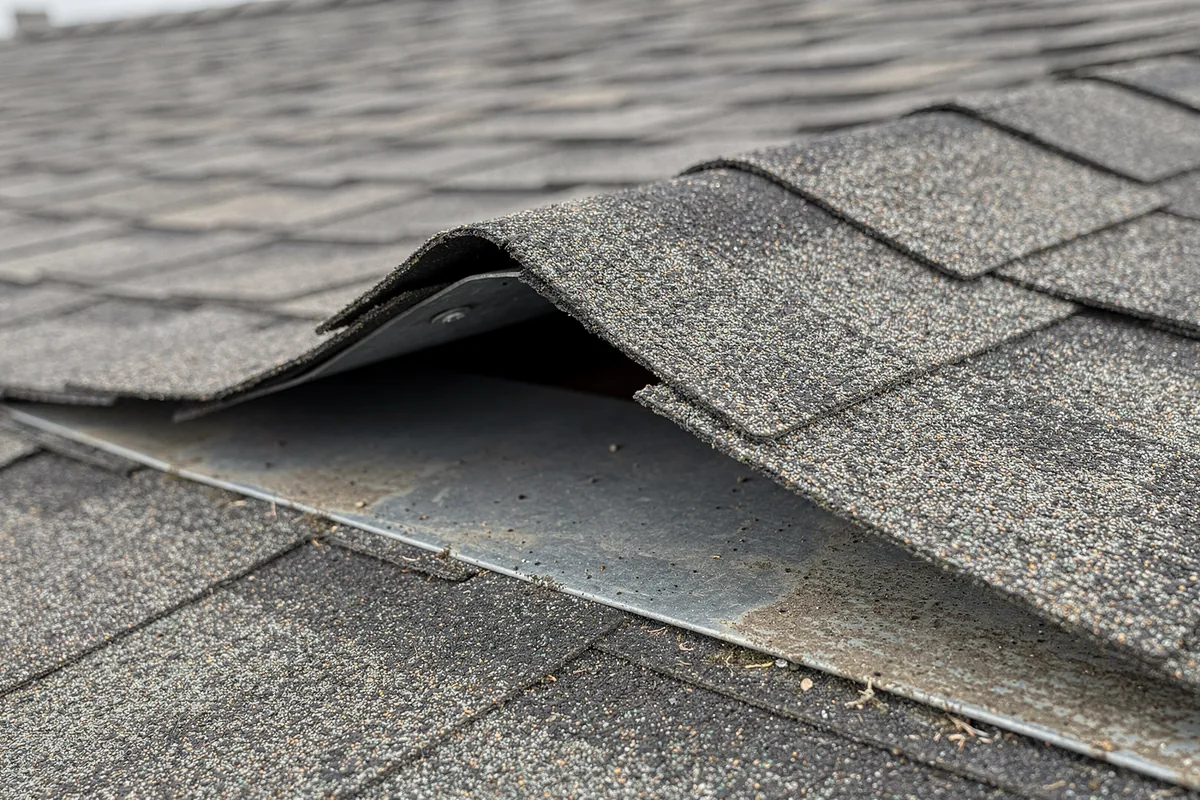
Edge metal and the starter course. Drip edge, rake metal and a sealed starter strip at the perimeter. Uplift starts at edges and corners, so this is where a cheap roof is cheapest and where it usually fails first.
Salt rated parts. Flashing, vent collars, pipe boots and fasteners that will not rust out in a few summers. Ordinary parts are a common reason a coastal roof leaks around a vent long before the field of shingles is worn.
Decking at a rate. No one can see the deck until the old roof is off, so the honest approach is a written price for each replacement sheet and a rough count, agreed in advance.
Read more on how a coastal replacement is sequenced and on what wind does to the edges.
Where the insurance money comes from on a coastal claim
Two separate policies are often involved near the bay: the homeowner policy for most perils, and TWIA for wind and hail. Each has its own deductible, and the wind and hail one is frequently set differently from the standard figure, sometimes as a percentage of the insured value rather than a flat amount. Find both numbers on your declarations pages before anyone climbs a ladder.
Replacement cost cover is usually paid in two instalments. The first is the depreciated value. The balance is released after the work is finished and invoiced. Skip the work and that balance stays with the insurer.
And the deductible is yours in full. Texas makes it an offence for a contractor to pay, waive or rebate it, so an offer to "take care of" your deductible is an offer to break the law with your claim. The detail is on the wind damage page.
Reading the estimate you are handed
Ask for the job split into tear off and disposal, decking at a stated rate, dry in and edge work, and the covering itself. Ask who books the windstorm inspection and when. Ask what the fasteners and flashings are made of. Then compare estimates line against line rather than total against total, and the reason one number is lower usually becomes obvious within a minute.
Questions people ask
- Why is a quote from a company across the bay so much lower?
- Usually because something coastal is missing from it. Check three lines in particular. Is the windstorm inspection arranged and scheduled into the job? Are the fasteners and flashings rated for salt air? Is the edge detail specified or just assumed? A price that leaves all three out is cheaper because it is a different roof.
- Who pays for the windstorm inspection?
- Ask before you sign, because it varies. Some companies build it into the price and some list it separately. Either is fine as long as the contract says who arranges it, when it happens and that you receive the certificate at the end.
- Is metal worth the extra money this close to the water?
- Sometimes. A properly fastened metal roof sheds wind well, but the panels, the clips and the screws all have to suit salt exposure, and the detailing around vents and chimneys is fussier than on shingle. Get both priced on the same scope and compare them over the years you expect to stay, not on the day you pay.
Where these numbers come from
- Roof replacement as an improvement needing a Certificate of Compliance (Texas Windstorm Insurance Association, checked 2026-09-29)
Last checked 2026-09-29.