Asphalt shingles within reach of the bay
Asphalt shingle is still the usual roof in Rockport, Portland and Corpus Christi, and it holds up here when it is rated and nailed for coastal wind. Before signing, get in writing the shingle's wind class, six nails a shingle, sealed starter strips at eaves and rakes, corrosion resistant fasteners, and a TDI windstorm inspection before the deck is covered.
Why shingles are still the default here
Drive through Rockport, Portland or the Southside of Corpus Christi and most of the roofs you pass are asphalt shingle. The reasons are practical. A shingle roof costs less up front than metal, almost any local roofer can patch it after a blow, and matching tabs are easy to find. After Hurricane Harvey in August 2017 shingle was what the rebuild could get quickly, so whole streets carry shingles from the same two or three years.
None of that makes shingle the wrong choice on this coast. It makes the way it goes on matter more. A shingle that is rated for high wind and nailed to the maker's high wind instructions behaves very differently in a tropical storm from the same bundle put on in a hurry. If you are weighing the alternative, the metal roof page covers what salt does to steel and aluminium.
Reading the ratings on the wrapper
Three test standards show up on shingle packaging and data sheets, and they answer different questions.
- ASTM D7158 wind classes. Class D is tested for 90 mph, Class G for 120 mph and Class H for 150 mph. Near open water on the Coastal Bend, Class H is the one to ask about.
- ASTM D3161 wind classes. An older fan test. Class F, tested at 110 mph, is the top class and often appears alongside a D7158 rating.
- UL 2218 impact classes. Class 1 to Class 4, about hail rather than wind. Class 4 is the toughest.
A rating describes the shingle in a test rig, sealed and nailed the way the maker specifies. It says nothing about the roof on your house unless the installation follows the same instructions, which is why the next section matters more than the label.
Where wind actually gets in
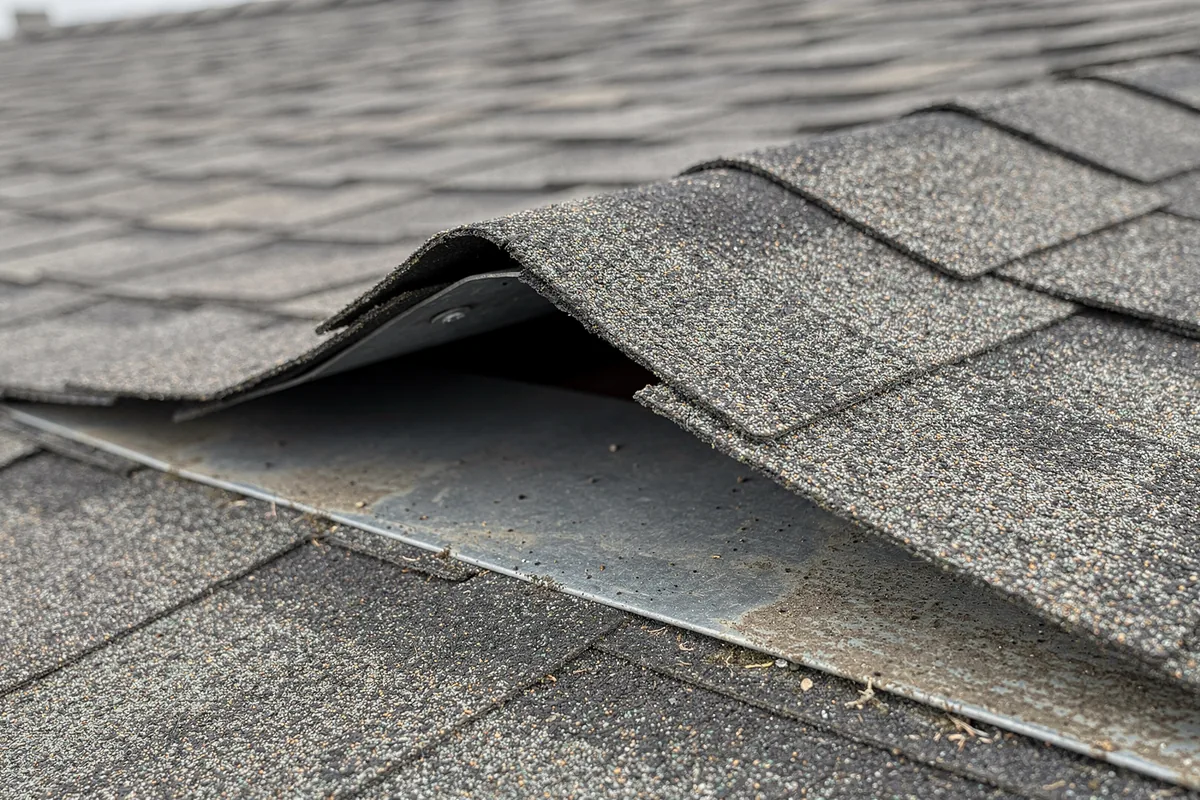
Shingles rarely blow off from the middle of a slope. Uplift starts at an edge, where wind curling over the eave or the rake gets under the first course and peels it back. Once one course lifts, the next one is exposed. Look at any roof after a tropical storm and the damage runs in from the edges and the ridge.
The details that stop it are cheap compared with the roof. Starter strips with a factory adhesive line at the eaves and up both rakes. Six nails a shingle rather than four, set on the nailing line and not overdriven. Drip edge fastened to the deck. Ridge caps rated for the same wind as the field. Underlayment held down with cap nails so it stays on if shingles do come off. What edge uplift looks like once it has happened is set out on the wind damage page.
Salt, sun and algae
Asphalt itself does not rust, but almost everything holding it down is metal. Plain steel nails, cheap drip edge and painted vent flashings corrode in salt air, and a shingle is only as tight as its fasteners. Close to the bay, ask for hot dipped galvanized or stainless nails and for flashings that will not rust out in a few summers.
The Texas sun dries the asphalt and loosens the granules that protect it. Granules washed into the gutters or piled at the foot of a valley are a roof losing its sunscreen. Dark streaks on shaded slopes are a different thing: algae, which likes humid Gulf air and is mostly a cosmetic problem.
Rockport and the rebuild roofs
In Rockport the shingle question is mostly about the roofs that went on after Harvey. Many are now eight or nine years old, and the ones laid in a rush tend to fail at the edges and flashings first. A few lifted tabs on an otherwise sound roof are a repair at the detail. Lifting along every edge points to a roof that was never fastened properly.
The windstorm inspection
Every town on this site sits in the TWIA windstorm area. If the house carries TWIA wind and hail cover, a new shingle roof needs a Certificate of Compliance, the WPI-8, from the Texas Department of Insurance, and the inspector has to see the work before it is covered. How that fits into a tear off is on the roof replacement page.
Before you sign for a shingle roof
Ask for the shingle by name and colour, its wind class under D7158, the nail count per shingle, the starter and ridge products, the underlayment, and the fastener type, all written into the contract. Ask who books the windstorm inspection and when. Texas does not license roofers, so those papers are your protection. Most local companies offer free estimates.
Sources: wind and impact classes as defined in ASTM D7158, ASTM D3161 and UL 2218 and printed on shingle data sheets; TDI windstorm inspection program and the WPI-8 Certificate of Compliance; Hurricane Harvey landfall, National Hurricane Center report. Checked 15 Nov 2026.
Questions people ask
- How long does a shingle roof last this close to the Gulf?
- Usually less than the wrapper suggests. Heat, ultraviolet light and salt air all age asphalt faster on this coast, and many roofs here are replaced after a wind event before they ever wear out. The nailing and the edges decide more of the real life of the roof than the brand on the bundle.
- Is an impact rated Class 4 shingle worth it on the Coastal Bend?
- It depends on the house and the policy. UL 2218 Class 4 is a hail rating, and hail is less of a threat here than wind. Some Texas insurers give a premium discount for a Class 4 roof, so ask your agent for the actual figure before paying extra, and make sure the wind class is right first.
- Can new shingles go on over the old ones?
- The residential code allows one recover in some cases, never a third layer. Near the bay most jobs are full tear offs anyway, because removing the old roof is the only way to see the deck and to let the windstorm inspector check the nailing before it is hidden.
- What are the dark streaks running down my shingles?
- Almost always algae, which thrives in humid Gulf air on north and shaded slopes. It is a stain, not a leak, and it does not by itself mean the roof is failing. Shingles with copper treated granules resist it, and a gentle wash, never a pressure washer, takes it off.
Last checked 2026-11-15.